
Article
Accelerating Patient Safety Improvement

Report of an Expert Panel Convened by the National Patient Safety Foundation
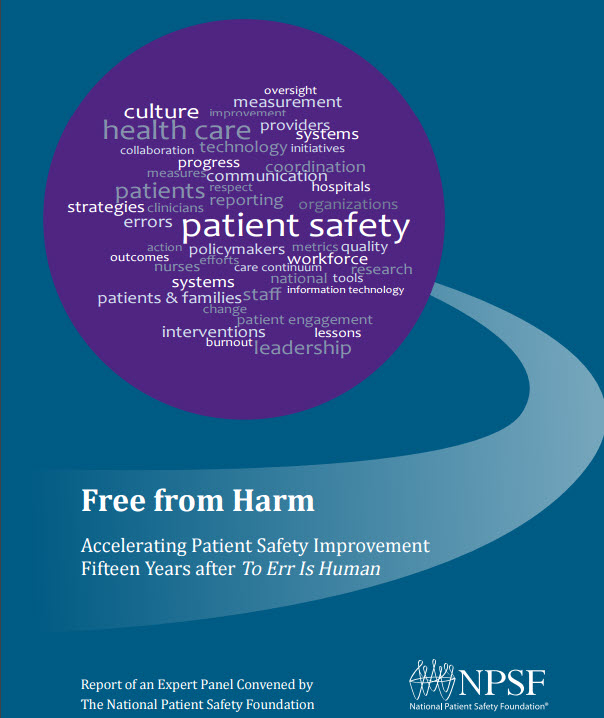
Fifteen years after the Institute of Medicine brought public attention to the issue of medical errors and adverse events, patient safety concerns remain a serious public health issue that must be tackled with a more pervasive response.
With a grant from AIG, the National Patient Safety Foundation (NPSF) convened an expert panel in February 2015 to assess the state of the patient safety field and set the stage for the next 15 years of work.
The results call for the establishment of a total systems approach and a culture of safety, and calls for action by government, regulators, health professionals, and others to place higher priority on patient safety science and implementation.
The report makes eight recommendations:
- Ensure that leaders establish and sustain a safety culture
- Create centralized and coordinated oversight of patient safety
- Create a common set of safety metrics that reflect meaningful outcomes
- Increase funding for research in patient safety and implementation science
- Address safety across the entire care continuum
- Support the health care workforce
- Partner with patients and families for the safest care
- Ensure that technology is safe and optimized to improve patient safety
Related Articles
Safety Culture and Risk Reliability in Health Care
Article
This paper explores the dynamics of safety culture and organizational resilience.

Are Attendings Liable for Residents’ Negligence?
Article
Is the attending physician for an inpatient legally responsible for all the care provided by the clinical team while a patient is in the hospital? The short answer to this question is: No.
Reducing the Occurrence of Malpractice Cases Involving Inadequate Patient Assessment
Article
While standardization—even automation—may be attractive, interventions to reduce errors during these critical initial stages of diagnostic assessment need to support the heuristics and mental shortcuts clinicians rely on to be effective and efficient.
PCPs Miss Chances with MIs
Article
Nearly a quarter of patients who present to emergency rooms with a heart attack had been seen with cardiac symptoms by their primary care physician previous 30 days. In almost half of those cases, the primary care physicians sent the patient home instead of to the hospital.