Newsletter
Diagnostic Errors Are Everyone's Problem
Sep 30, 2021
Since the 2015 Institute of Medicine publication of Improving Diagnosis in Health Care, considerable attention and resources have been focused on protecting patients from errant or significantly delayed diagnoses. Certainly, all clinicians want to get this fundamental aspect of patient care right, but much of the work in this realm of patient safety has focused on just four specialties: internal medicine, family medicine, emergency medicine, and radiology. An analysis of more than 70,000 medical professional liability (MPL) cases in CRICO’s national MPL database indicates that those four specialties account for just half of all diagnosis-related MPL cases. The other 50% fall under the responsibility of more than 70 specialties and services, and caregivers in those services may be missing out on efforts to improve diagnostic skills and systems.
71,339 MPL Cases Closed 2010-2019
14,818 Cases with a diagnosis-related allegation
- 7,402 (50%) Diagnosis-related cases involving Emergency Medicine (16%), Radiology (13%), Internal Medicine (11%), or Family Medicine (11%) as the responsible service
- 7,416 (50%) Diagnosis-related cases not involving the top four responsible services (no single service accounts for more than 4%)
Regardless of who is caring for the patient—and who is facing diagnostic challenges—the most prominent underlying cause of diagnostic errors and delays stems from the patient assessment process.
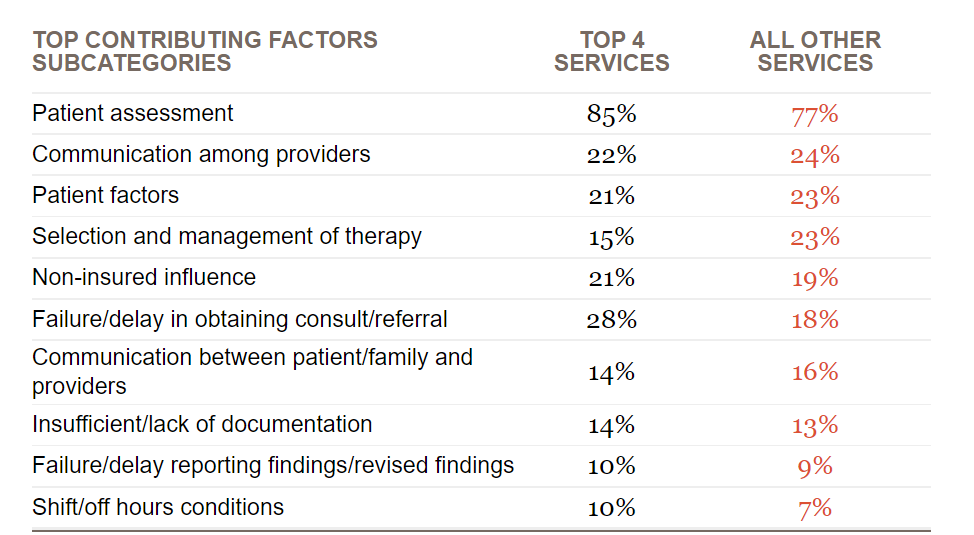
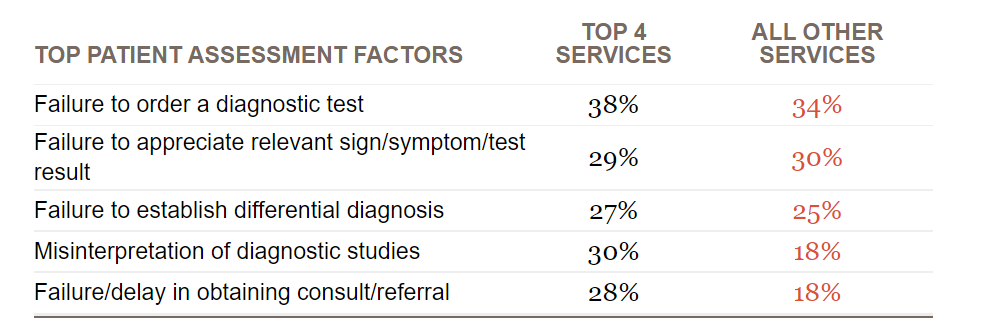
The universality of diagnostic pitfalls across all specialties and services is evident again in the list of contributing factors specific to the patient assessment process.
Also worth noting: for both the top four services and the groups outside those four, one quarter (26%) of the missed diagnoses are some form of cancer.
In follow up to the release of Improving Diagnosis in Health Care, many organizations have formed—or refocused their attention—to help clinicians and their patients get to the right diagnosis and treatment as directly as possible. Everything from cognitive processing to electronic health record design is under scrutiny and the subject of improvement initiatives. The MPL experience outlined above indicates that those critical efforts should reach out to all specialties and services.
Additional Materials
- Society to Improve Diagnosis in Medicine
- Diagnostic Errors in Primary Care
- Best Medical Practices: Maximizing Skills, Minimizing Risks (CME course – November 13, 2021)
Latest News from CRICO
Medication Errors and Malpractice: What a Decade of Cases Reveals About Risk Across the Care Continuum


Utilization of Electronic Health Record Sex and Gender Demographic Fields: A Metadata and Mixed Methods Analysis

Teleradiology Medical Malpractice Cases