“Often, in fact in my opinion most often, I can set an operation up so that the operation goes more smoothly with the other person doing something that the patient might think oh gosh, that surgeon should be doing that.”
Dr. Andrew Warshaw, Surgeon in Chief at Massachusetts General Hospital, likes to tell his patients a lot before they agree to have him operate on their pancreas. But recent clarifications from the federal government means he won’t have to tell them by name exactly who will be involved during the surgery and what their specific tasks will be.
“You don’t always know who is going to be the resident. Sometimes you do, sometimes you don’t or there can be changes, so you can’t be categorical about that. The bigger problem as far as I’m concerned in being that specific is knowing in advance or being able to prescribe in advance exactly who is going to do what.”
Turns out the federal government recognizes this. Despite written guidance in 2004 that said patients must be told ahead of time the names of residents and their specific functions during a procedure, the Centers for Medicaid and Medicare Services, or CMS, backed off in 2005.
A representative of the agency now says it expects that by the end of 2006, it will put in writing some revision of rules that have had risk managers pulling their hair out for more than a year. Hospitals have been trying to apply changes in the CMS informed consent surveyor guidelines that not only address who will be doing what, but also require a list of alternatives discussed, and a witness to the patient’s signature.
“So there was a lot of confusion and discussion in hospitals and with CMS as to what they actually meant, and it definitely took some time for them to finally clarify that, especially for academic medical centers.”
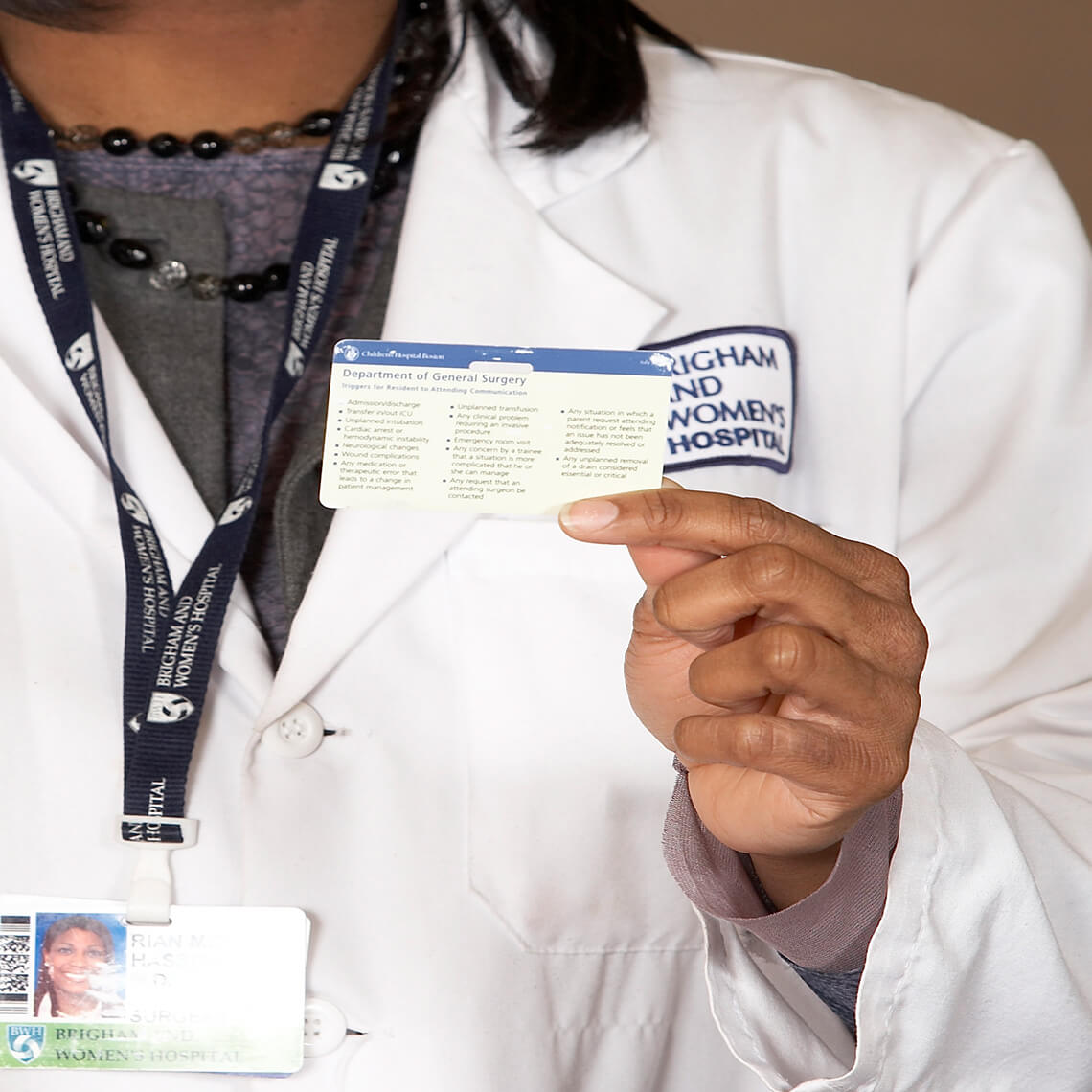
Janet Barnes is Executive Director for Clinical Compliance and Risk management at Brigham and Women’s Hospital in Boston. Barnes says new clarification from Medicare relieves some of the tension, particularly around a new requirement that attendings tell patients who will be performing what during surgery.
“What CMS is telling us is that we need to be informing patients of the types of individuals who would be participating in their care. So that the surgeon would say, ‘I performed this case and generally I have a second year surgical resident who is assisting me.’ And to the extent that that person may be doing significant portions of the procedure, the surgeon needs to be informing the patient of what those portions of the procedure are that the resident or the physician’s assistant will be performing.”
Other new requirements from CMS call for including on the consent form the list of alternatives discussed with the patient—and that they went over the risks and benefits of those alternatives. According to Captain David Eddington of CMS, the risks and benefits of the alternatives don’t have to be listed on the form—just the alternatives themselves that were discussed .
Eddington also says that another new rule calling for a signature by a witness does not require the witness to be a professional, nor does the witness have to be present for the consent discussion, only the patient’s signature.
Janet Barnes says some physicians have questioned the necessity of the new requirements and the practicality of incorporating them into their workflow. Software may be helpful in that regard. For example, the VA health system has been using a leading application called ImedConsent from Dialogue Medical of Georgia.
Dr. Aaron Fink is a general surgeon and Chief of the Surgical Service at the Atlanta VA Medical Center.
“It is, I think, a huge improvement, particularly given the fact that we have a very robust electronic medical record, and they have done a tremendous amount of work to make this program interface very nicely with our software packages. It obviously has a huge benefit in terms of documentation first and foremost. I think there is a potential role for improving the consistency of information delivered to patients as well, so I think from those two arenas I am very, very impressed.”
Dr. Fink points out that most consent software can also provide easily printable education material for patients that physicians can go over and patients can take with them. Studies have shown that patients legitimately don’t remember key elements of informed consent discussions, often because of heightened anxiety.
NQF, The National Quality Forum, has included in its 30 patient safety recommendations a “repeat back” technique. The provider asks the patient to repeat in his or her own words what the surgery is, what it involves, the risks, and alternatives.
Dr. Warshaw of MGH in Boston encourages physicians to resist the temptation to view the consent process as a just a step in the rush to get things done. He believes the discussion should be directly between the patient and him, not a nurse or resident. Part of the reason is that he thinks patients are more likely to remember what he says. He also involves family members in the process.
“In the best circumstances they will be helpful in the discussion. They will often be the decision makers rather than the patient. I think the end result is better if you have family participation, but you have to be ready for it and you have to put the time into it and have to be patient enough to field questions that may be irritating or stupid or off the track or in their interest rather than the patient’s. All of those things can happen, but that’s the price of a better communication.”
Dr. Warshaw says the right kind of informed consent process is also a method of strengthening the physician-patient relationship.
“I see informed consents that others have gotten, and there will be a lot of rote-type items like possibilities include death, bleeding, infection or a laundry list of horrendous things. That, as far as I’m concerned, is useless. It first of all does not get you off any hooks in case death, infection, bleeding or those things happen but simply the fact that you have them listed there is not terribly valuable. If that’s all you have done is put those things down on paper and then had somebody sign it, you haven’t really done anything useful. I think the same kind of rote requirements that CMS has put in are potentially equally useless, so I really fall back on that communication with the patient and the patient’s family or the patient’s significant other or whatever it happens to be. Doctors are much more likely to get sued or less likely to get sued based on what’s been termed loosely their personalities, but this is one aspect of that. You establish a relationship with the patient around this discussion. That’s the biggest protection you’ve got.”
Janet Barnes says that the most optimistic view of the new CMS rules is that they may force extra discussion between physicians and patients, and encourage a true informed consent process, rather than quick signatures on a form.
“I would hope the reason why physicians would embrace this is because it only helps them in the end. From a legal perspective, it would be harder for a patient to come back and say I never knew that residents were involved in that level of care and had I known that, I never would have agreed to have the surgery if, in fact, a bad outcome occurs.”