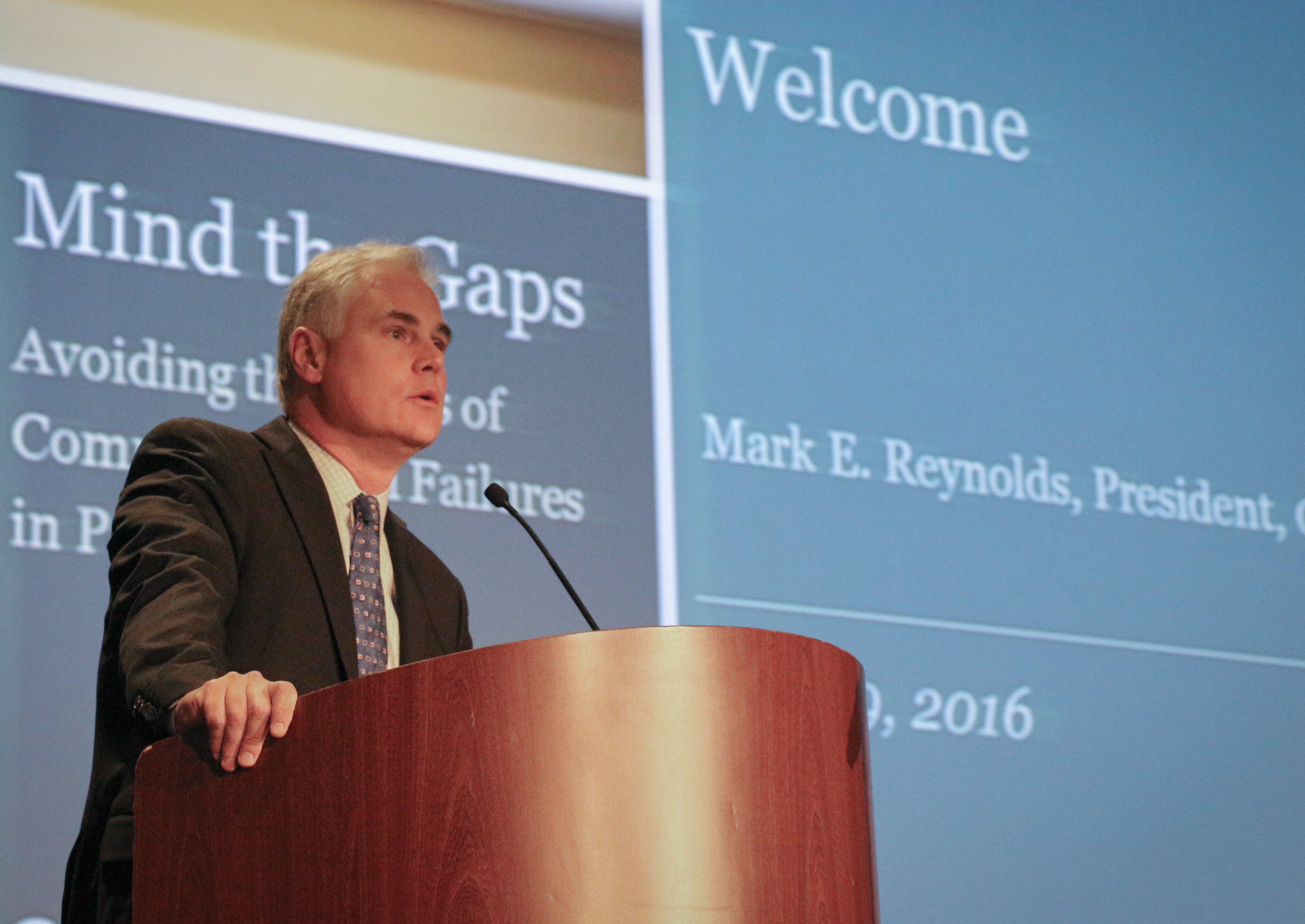
The messages were clear and hopeful for those who are working to improve patient safety. But for 200 physician and nurse leaders, researchers, and hospital administrators who attended a June 2008 conference in Boston, the message was also challenging and a bit cautionary: in the mission to reduce errors and medical harm to patients, computers have a lot to offer—yet it's not all good. In some cases, the solutions themselves have caused problems that can harm patients and lead to lawsuits.
The conference was sponsored by CRICO/RMF, the malpractice insurance and patient safety company owned by Harvard Medical School and its affiliated institutions. People at the leading edge of Health Information Technology—or Health IT—shared their war stories.
In one category of "Decision Support," the effort is to reduce cognitive mistakes, or flaws in thinking. Dr. David Bates is Chief of the Division of General Medicine and a researcher at Brigham and Women's Hospital in Boston. Dr. Bates serves on the World Health Organization's Global Alliance for Patient Safety. He shared some success stories for IT and patient safety, starting with a decision support tool for renal dosing.
“This is a study in which we looked at the affect of delivering real time decision support for patients with renal insufficiency at the Brigham. And the way that this works is the computer knows the patient's age, their gender; you have to get the provider to supply the weight which can be a challenging thing. But it can then calculate a … and suggest the appropriate dosage of medication for a patient. Now it turns out that a lot of our patients today have renal insufficiency. In this study 42 percent had some degree of renal insufficiency, and yet before we put this decision support in place people were only getting the right dose and frequency 54 and 35 percent of the time. After we turned on the decision support that improved to 67 and 59 percent of the time—still not perfect, but substantially better. And notably patients stayed in the hospital about a half a day less after we did that.”
Dr. Bates pointed to a study by Hahn et al that showed the potential down side of a technology intervention at a children's hospital. Computerized physician order entry (CPOE) was introduced to reduce errors and improve efficiency. Yet mortality increased from 2.8 percent to 6.3 percent after introduction of commercial computerized physician order entry system.
Dr. Bates said the study's results don't suggest a cost-benefit question, because most people see a high value for CPOE. But implementation can make or break such a project.
“First of all, CPOE was introduced very rapidly over six days across the whole institution. And by contrast we did this over about 2 ½ to 3 years depending on how you count at the Brigham. We were doing this with a much earlier version of CPOE than was the case here, but six days is definitely quick. Second, after implementation, order entry was not allowed until the patient had actually entered the hospital and had been logged into the system, and in the past what they would do would write a lot of the orders while the patient was in transit on the way to the hospital. Next, after CPOE implementation they took all the drugs including the vaso active drugs, which many of these kids needed and moved them to the central pharmacy. They also implemented a rule that said the pharmacy could not process medication orders until after they were activated, so that built in another delay. And they made the call, which may seem not that important, but I think was,
that many of the order sets were not available initially. They just didn't have time to put them all in and they figured they'd do it later. Well, it turns out that when you write orders using order sets with CPOE it is quite a bit faster to write orders, whereas if you write single orders it is much slower. So, that built in even more delays and the net result I think was substantial delays in care delivery. The overall implication is that it is possible to cause serious adverse consequences with a bad implementation.”
John Glaser is Vice President and Chief Information Officer for Partners Healthcare System, which includes Brigham and Women's and Massachusetts General Hospitals in Boston. Dr. Glaser says the value of decision support tools in health IT is indisputable, but these implementation risks challenge everyone.
“The strategy can be poorly aligned with the goals of the IT. So, if IT is solving anything, it is solving a problem different than what is being envisioned early on. There can be governance processes over whether we go left or we go right, introduce incentives or don't introduce incentives, introduce centers or not introducing centers. And if those governance processes are flawed or inefficient, etc. the movement and the crispness of decision making that need to surround it is not occurring here. There can be times that we fail to appropriately engage the clinical staff. So, if we're developing an answer, it is not an answer that is actually all that helpful or subhelpful to them. The work flow is wrong. It doesn't think the way they think or things along those lines. We can also believe that once we turn it on and go live we're done, and in fact the real work of process change has started and the real work of support and training has started and needs to go on in an ongoing way. The others: we can sort of fail to monitor progress. It's striking to me how many times we write these things up about all the wonderful things that will happen when you implement it and then you never check to see whether we got these gains we thought were going to occur. And maybe we did, but more likely we didn't and so we're wandering around in a fog at a 40% gain happy and moving on to the next particular challenge. So, there's a wide variety of things that can happen on the way in between the idea of conceiving an idea and getting it in, which causes to deliver suboptimal value.”
Glaser outlined several risk areas to monitor as well, with implementation of health IT. One is that over time, many new rules are layered over old rules for such decision supports as drug/drug interactions and order sets. Eventually these may become outdated or in conflict as the knowledge base and policies that feed the electronic systems changes.
“The other area we can fail to manage is associated with the work flow. And that is it is tricky to introduce these into highly specialized, highly variable work flow at a very micro level. When does the physician write the prescription? In the exam room with the patient or later on in the hallway? We don't understand all these work flows and it doesn't fit and as a result of not fitting they skip steps. One of the more interesting things we've looked at is to what degree are our prescriptions written using e-prescribing that's distinct from on paper. Pulling out the issue from the timing of narcotics, which still have to be on paper and about 3 out of 4 are doing it. Why, because sometimes it just doesn't fit with the work flow of the screen design. So, there is a failure to really understand and go after that and as a result use is suboptimal even if you have great physicians like Clause and Dan here to the left of me who just don't have time and it doesn't fit particularly well. … The third can be data integrity problems. Now there can be obvious data integrity problems where it is just gone or it is corrupt and it is quite apparent. There are some more subtle ones that occur where the interface engine is not working, but the physicians don't know it. We're increasingly struggling with the complex notes. We have our physicians write their notes in word and their pasting in pictures and videos, etc. and then we try to translate them to dumb down views, and have instances where we've lost characters or pieces of the text and things like that. So, there can be very subtle issues with the data, which can be hard to detect and may not be noticeable for a long period of time.”
From Aurora Health Care in Milwaukee, Wisconsin, Judy Murphy shared some experiences implementing decision support tools for a multi-site health record initiative. Murphy is Vice President, Information Services at Aurora.
She divided Heath IT into programs that "push," information to providers and those that "pull." providers to the information. Murphy prefers push" technology that places the decision support information in front of the clinician during episodes of care, rather than waiting for the provider to go somewhere and pull the info.
Alerts are examples of "push." At Aurora, the electronic patient information serves as both real-time quality data for performance measures, and as decision support.
“An example here of starting something off with an alert might be this example, which is an elevated troponin, which could be indicative of an AMI—and pushing that out initially to the physician to ask them, ‘gee, did this patient have an AMI because if they did, we want to start tracking them against the CMS and Premier clinical performance measures.”
Murphy says the same kind of dual-purpose "push" information can be low-tech as well.
“Health maintenance is a good example. If you present a form in the ambulatory setting that talks about the things that ought to be done in health maintenance—I'm not talking about an alert that interrupts you; I'm talking about just a form that you happen to go to maybe document a flu immunization—it creates decision support, because you're looking at that as the provider and say, ‘oh, oh, I wonder if I should be doing that because it is at least listed here. Oh gee,' you know, or if you went in and you had a diabetic and you're going in to look at the hemoglobin A1c, if right below that is the assessment for the feet are listed, you're kind of forcing that thought process without even this interruptive alert. So to really think broadly when you think of decision support, it can be as much as a row on a flow sheet or a place on a documentation form that is going to cause somebody to change their thinking.”
[music fade-in]
Coming up…information technology that helps with follow-through, like test result or referral management or bar-coding to prevent medication errors. What are the risks? And how can they be managed?