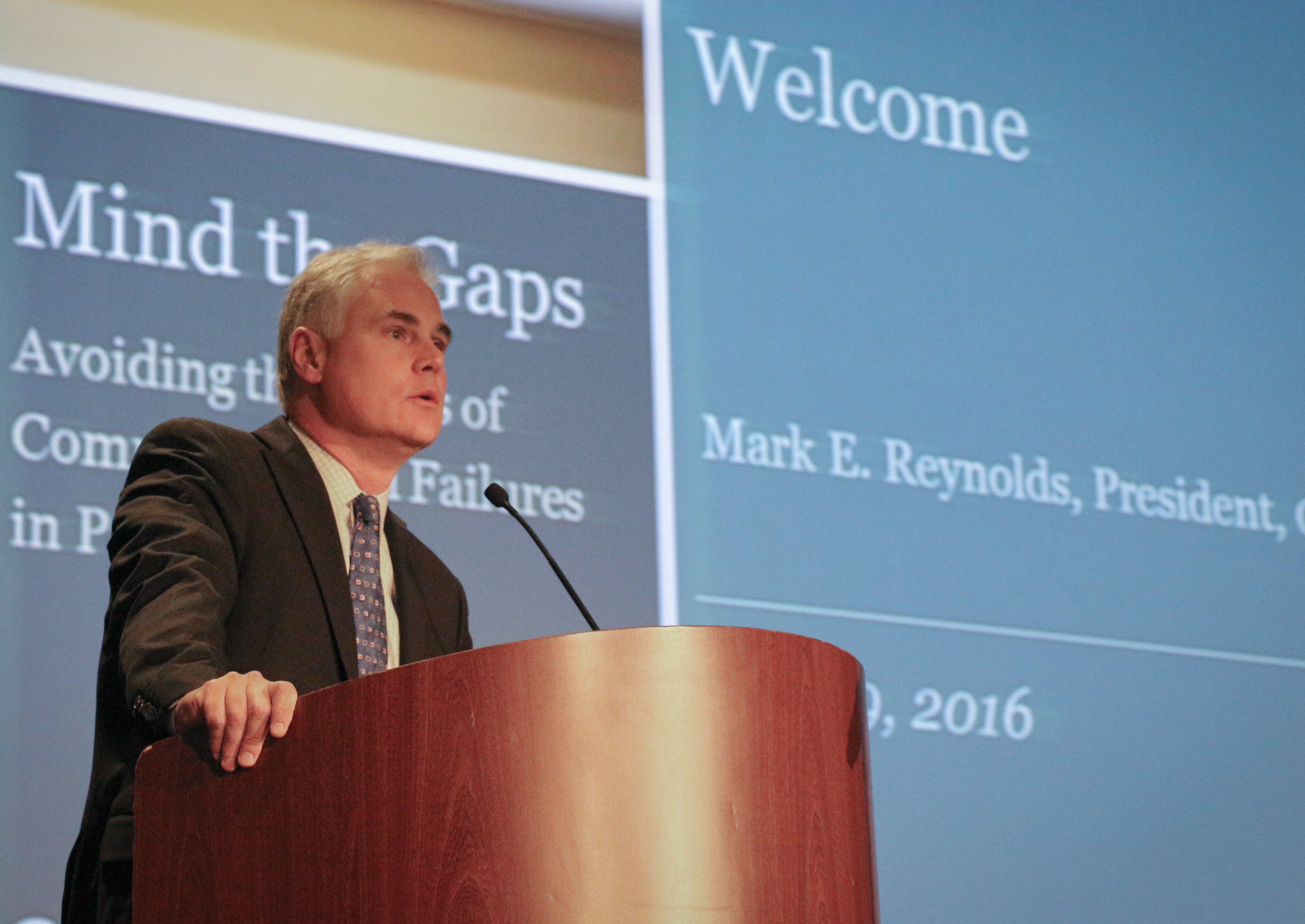
In November 2007, nearly 100 surgeons from across the country spent a highly interactive
day with a series of panels to discuss top barriers to making care safer in the
surgical environment.
It was called a “Surgery Summit,” and a key challenge that quickly emerged involves
the concept of teams and team processes. Typical hospital units do not organize
surgical procedures with intact surgical teams.
As the “lone ranger” model of surgery done by a highly skilled surgeon surrounded
by people responding to commands gives way to a safer model of an integrated professional
team, there’s a problem: The scrub techs, the nurses, the circulators, are rarely
the same from day to day or procedure to procedure. Many attendees at the conference
felt that this undermines efforts to use team methodology to improve outcomes.
Panelist Andrew Freiberg, Chief of Adult Reconstructive Unit at Massachusetts General
Hospital, recognized the issue when an audience member raised it.
“One of the mistakes I think we make is that we assume that any scrub nurse, any
scrub tech, any circulator, they are equivalent. The fact is, it is not true. We
always like to say this to our administrative leaders, ‘You know, I tell you what,
we’ll change your secretary every day because we are going to give you a good secretary,
we are going to give you a good legal assistant. We are going to change it every
day. We are going to give you new ones once in a while, and we are going to let
you teach them because it is important to have new ones.”
“It is really wild when you are in the operating room and you show up, and you’re
operating on the CEO of blank, and it’s ‘Bring Your Scrub Tech Student to School
Day,’ and you’re ‘what?’ You have to think about this because the person that I
usually work with is the person that I prefer to work with and when I work with
her, my environment is different. She sees things that I don’t see. …it’s a very
dynamic environment. And who you work with and how that is structured is very important
to the safety and success of the whole day”
One of the symposium’s panelists runs Children’s Hospital in Boston. Dr. James Mandel
is President and CEO, as well as a Professor of Surgery at Harvard Medical School.
An audience member asked him directly:
“I’d like to go back to the teamwork and ask Jim to comment on whether it is in
fact practical to have these dedicated teams in the operating room or is that not
practical from a hospital standpoint? Because if it is not practical, we shouldn’t
be dreaming of it because we will create physicians who can’t operate unless they
have their perfect team together.”
[new voice, Dr. Mandel]:
“I think it is practical in some cases but not in all. And what we
have done at least around our center of excellence, we have tried to get a whole
dedicated team both intraoperative, postoperative, etc. So whether in the Neurosurgical
Services, in the Cardiac Services, in the Orthopedic Services, we have tried to
get dedicated teams that extend both from the entryway all the way to the postoperative
period.
“It is not going to be possible in all cases. In my specialty, there are nurses
and staff that tend to work there because they like to work there and we have known
each other for decades, but I don’t think from an institutional point of view you
can have a dedicated team for every specialty. But I do think for those high volume,
high risk it is perfectly possible to get the continuum of care both pre, intra,
and postoperatively. Certainly, our cardiology team is the most representative where
you have virtually everybody on the team, whether it’s preoperative, intraoperative,
postoperative, etc., all of which are members of the team that are quite separate
and distinct. We are getting there with orthopedics. We have not done quite as well
in some of the other subspecialties.”
Dr. William Berry was a cardiothoracic surgeon in California who now does research
in patient safety and serves as a surgical consultant for CRICO/RMF, the patient
safety and malpractice company for the Harvard medical system. Dr. Berry’s former
institution pursued intact teams for his specialty.
“In the last hospital that I worked, this came to a head and we got our team. Not
circulators; no one could be in the heart room, number one, who didn’t want to be
in the heart room, because that was a huge problem, people who would get put in
there who didn’t want to be in there, and no one would be in there who wasn’t taught.
I empathized totally with the student-of-the-day thing, and it used to drive me
crazy. Another piece that drove me nuts with that was the fact that, again, administrators,
God love them, they have to be there, but administrators would have very little
appreciation for the value of someone who had been trained. So very small salary
increments or improvement in job benefits or whatever would be put aside, to lose
someone with 15 or 20 years of experience who was going to cost a half a million
dollars to retrain in terms of the efficiencies that were induced and those kinds
of things, so I am a big supporter of intact teams whenever it is possible.”
Dr. Berry noted that simulation centers in the Harvard system are working with intact
teams to improve team skills that they are already good at. Panelist Dan Jones runs
a surgical simulation center at Beth Israel Deaconess Medical Center, and he suggested
one concept to help with surgical teams that are not intact.
“Our nurses have set up in the simulation environment a proficiency rating for our
nurses and our scrub techs. So recognition rather than money being the end result,
of saying you’re a ‘Level 5’ at a lap/chole case and you’re a ‘MIS super user,’
whereas someone who is a 1 or 2 is a ‘needs improvement’ if they want to do minimally
invasive surgery cases. So there is at least a concept of nurses assessing nurses
as ongoing evaluation to sort of see who knows what, so that that information can
be used to see who could go into a room and who should not go into say our endo
suite MIS rooms.”
[new voice, Jo Shapiro]
“Jo Shapiro, Surgery at the Brigham. To the point about
intact teams, though I think we should work towards that, it is the ideal, I think
it is probably impractical in all situations. And what we can do is we can try to
change the culture so that when you walk into an operating room, whatever your role
is, you know that in that operating room your input will be welcomed, that you will
be part of a team, that everyone will know your name because it will be part of
a briefing, and that you will have an opportunity afterwards to learn from how the
operation went in a very safe environment. I think that’s what many of our institutions
are trying to do.
It is the concept of a just culture. For example, we are always going to have new
trainees with us, but they will understand that this is the environment that they
are going to walk into. So I think we can try to have intact teams because they
are wonderful, but in the situations where they are not, if we change the culture
enough, it will be almost irrelevant really because everybody will have a shared
mental model of what it means to operate at the Brigham or operate at any of our
hospitals.”.
[new voice, David Roberson]
“David Roberson, Otolaryngology at Children’s. I am
going to just echo and expand. If you walk in a room and there are a bunch of strangers
there, one response that I’ve adopted in the past was to roll my eyes at my residents,
and say, ‘oh my God another day.’ And the other response as to whether the culture
has changed or not is stop and say ‘we’re doing this operation, do you understand?’
The nurse may know 90 percent of what he or she needs to know, but if you give them
the chance to say, ‘well this part here, Dr. Roberson, I don’t understand what is
going to happen there,’ talk about it before. I think you can get an awful lot of
the benefits of team by having the right pre-op briefing and the right conversation
before the surgery.”
A surgeon who attended the conference from Swedish Hospital in Seattle saw how he
could plug these concepts into a new program that he’s been developing at his institution.
Dr. David Hanscom is an orthopedic spine surgeon. For more than a year, Dr. Hanscom
and his colleagues have been using a protocol designed to promote the view of surgery
as a performance, rather than a series of tasks that lead to an outcome. Now, instead
of a rushed entrance right before the operation, Dr. Hanscom spends up to 45 minutes
getting the room ready and briefing the personnel on every stage of the surgery.
It’s something that he calls “Team Building on the Run.”
He describes a recent spine surgery, where he added to his process the concept of
an “extended time out,” a concept that he brought back with him from the conference
in Boston.
“So the patient is now asleep on the table. I pulled the entire team together. I
have been talking to them for 45 minutes, and I went around the room and asked everybody,
I said ‘we are going to do the extended time-out.’ I had everybody say their first
name and last name, and we reviewed the process with each person that I had gone
through. This includes x-ray tech, the spinal cord monitor, the reps from the instrument
companies who are going to be there.
So I went through in detail what we are going to do. That took about three minutes.
Everybody’s name was already written on the board per myself. Then we turned the
patient over and then we did the final safety pauses before we did the incision.
So we took a whole day of 9 hours that could have been really quite chaotic and
turned into a really nice smooth performance.”
That also reflects a trend Dr. Hanscom has seen, of steadily declining complication
rates since turning to a performance paradigm and “team-building-on-the-run.” Beyond
the implications for improved patient safety, Dr. Hanscom reports that nurses, anesthesiologists,
and staff are embracing the change in their work environment. The increased efficiency
that results—with fewer distractions and missing equipment—may reduce error, but
it definitely improves the provider’s work life.
“In the 20 years I’ve done this, this has never happened. I’ve never gone through
cases like this without being frustrated and not finding instruments and people
were in and out of the room, and it just changed my entire surgical experience.”